Theory of Constraints
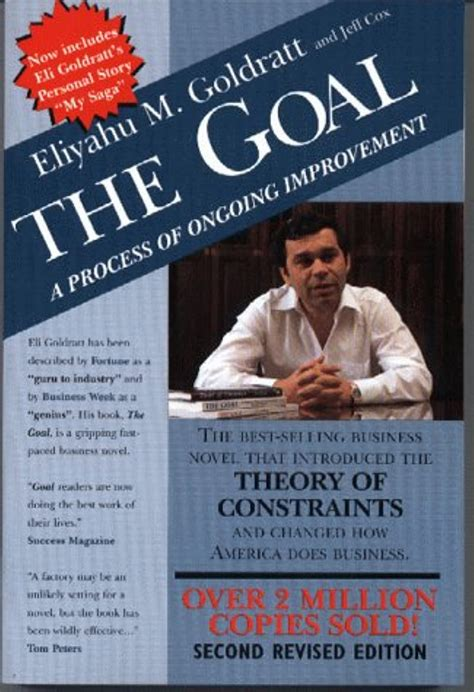 The Theory of Constraints is a management paradigm that views any manageable system as being limited in achieving more of its goals by a very small number of constraints. There is always at least one constraint, and TOC uses a focusing process to identify the constraint and restructure the rest of the organization around it. TOC adopts the common idiom "a chain is no stronger than its weakest link". The theory is explained in Goldratt's book The Goal.
Drum-Buffer-Rope
The Drum-Buffer-Rope system or DBR is a key concept in the Theory of Constraints and thus Kanban.
In The Goal, there's an illustrative story of a boy scout troop that was getting too spread out on their hike.
DBR's purpose is to balance the flow of production, here the scout leader used it to keep all the scouts hiking at the same pace. The slowest scout is the system's bottleneck, and his pace is the constraint.
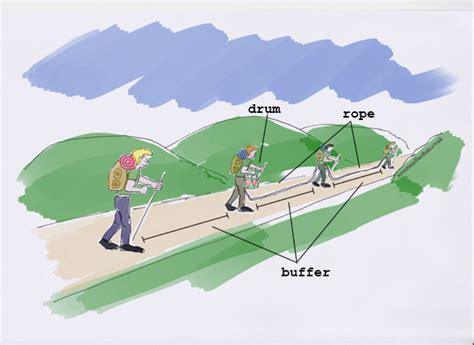
To implement, the pace-setting scout marks out their pace by beating a drum. The slack in the rope tied to the first scout and slowest scout is the buffer that protects the pace on the hike, while the inventory in front of the constraint (i.e., upstream) is the buffer in the factory.
The rope gives each scout feedback: to slow down if it tightens (i.e. the buffer gets too small) and to speed up if there's too much slack (i.e. the buffer gets too large).
DBR keeps even spacing between the scouts and thus creates synchronized flow. Thus, the rope enforces the pace on the hike, just as a pull system enforces the pace in the factory.
| Concept | Purpose or Function | Scout Troop | Factory |
|---|---|---|---|
| Drum | Sets the pace | Slowest Scout | The Constraint |
| Buffer | Protects the pace | Slack in the rope | Inventory in front to the constraint |
| Rope | Enforces the pace | Rope tied between the first scout and the slowest scout | Some type of pull system, e.g., kanban type or OPT schedule |
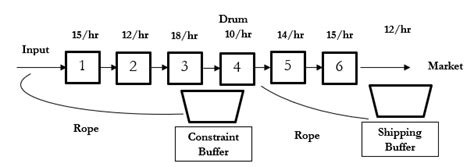
Here, station 4 is the slowest section, so it's the drum. It is wasteful for stations 1, 2, and 3 to produce more goods than station 4 can consume, those would be excess inventory. This system also has a constraint at shipping. A DBR system keeps each station working at a pace of 10 units per hour.