Zendo
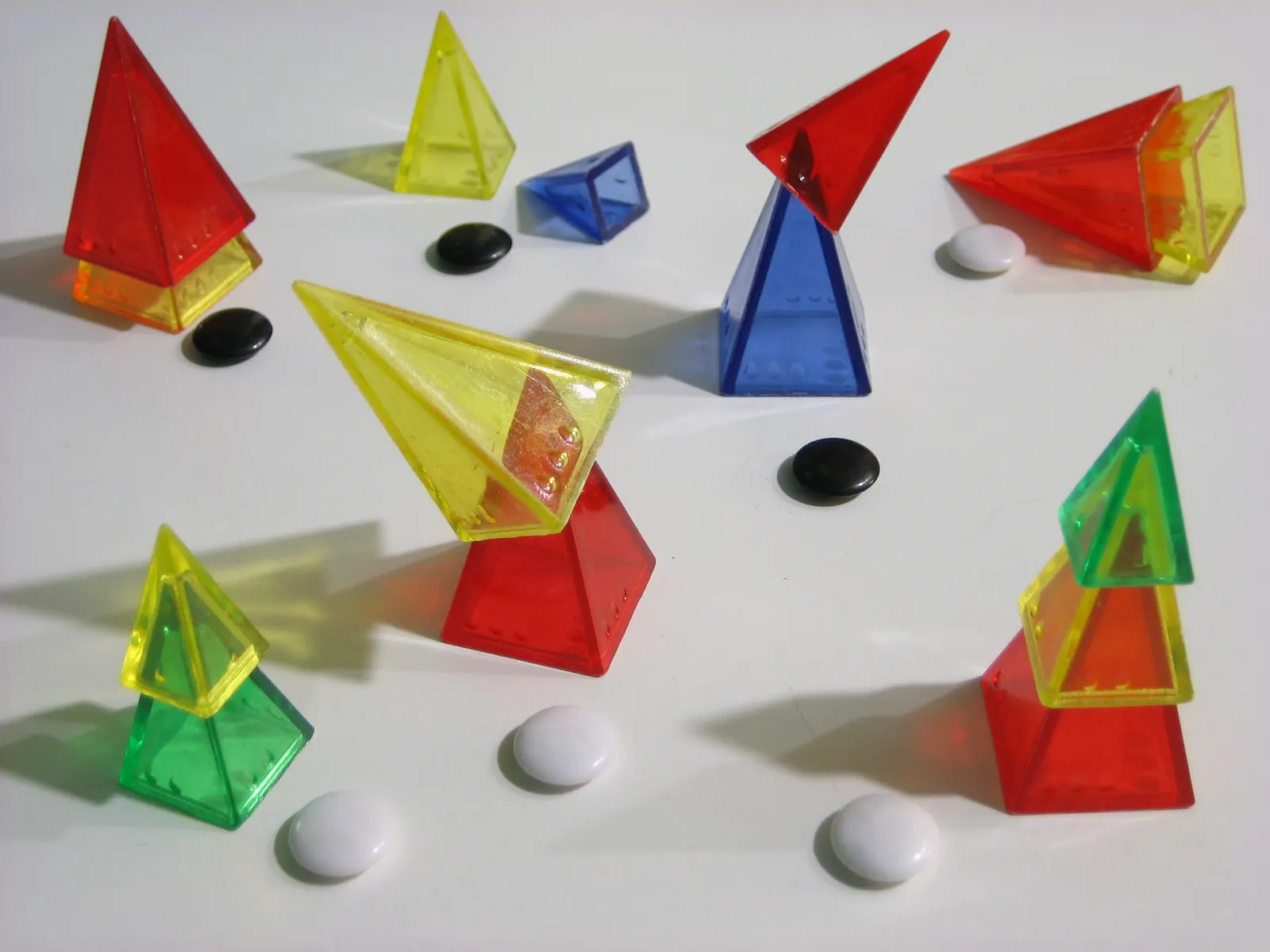 Zendo is an Abstract game of inductive logic in which one player, the Moderator, creates a secret rule that the rest of the players try to figure out by building and studying configurations of the game pieces (called "structures"). The first player to correctly guess the rule wins.
I learned this game from [redacted], and started teaching it to others when I got my purple bag of Looney Labs games. I've introduced it to my developer friends, such as [redacted] at MDC and [redacted] at TSYS. My first recorded play is in 2006.
Gameplay
Zendo uses Looney Pyramids as designed by Kory Heath, and it was released as a standalone game in July 2003. It can be played with any set of pyramids, though. Later standalone versions of the game also included blocks (rectangles), and wedges.
In addition to pyramids, you need two colors of marking stones and some form of guessing stone to give to players. Pente stones are the most commonly used item.
The game originally had a Zen koan theme. The Moderator was called the "Master"; the other players, "students". Structures were "koans". Secret rules were of the form "A koan has the Buddha nature if…", sometimes abbreviated as AKHTBN.
Later versions use more general language to make the game more accessible. The "quiz" action used to be called "mondo", for example. Use of the word "Mu" was encouraged.
While having pyramids and Pente stones are helpful, I've had success playing the game on a whiteboard at work. I hear some forum uses have played in text, using letters to build structures.
Secret rules
Some examples of rules, from easiest to toughest:
- correct if it has at least one blue pyramid.
- correct if it has exactly three pyramids.
- correct unless a red pyramid touches the table.
- correct if no medium pyramids point at yellow pyramids.
A rule that satisfies the picture is, "it must include an ungrounded yellow piece".
In Zendo, each structure is considered to be self-contained. Consequently, a rule cannot reference another structure or the outside play environment. Examples of disallowed secret rules are "must match the initial structure" and "must contain a piece pointing west". (This is known as the "Spock rule". Imagine the structure is beamed to Spock, Spock marks the structure, then beams it back.)
Rules can be either specific (i.e. must contain exactly three red pieces) or general (i.e. must contain at least three pieces that are all the same color). They can be simple (i.e. must contain exactly one block), relational (i.e. must contain at least two touching pieces), or make use of multiple attributes (i.e. must contain at least one yellow upright pyramid).
More complicated rules can involve "and phrases" (i.e. must contain a red piece and an flat piece), "and/or phrases" (i.e. must contain either a red piece or an upright piece or both), or number relationships (i.e. must contain more upright pieces than weird ones). Particularly complicated rules might contain "both-or-neither phrases" (i.e. must either contain both a red piece and an flat piece or neither of these pieces).
New moderator advice
Keep the rule simple. Avoid compound requisites ("and", "or") and avoid arcane math, like prime or square numbers. The most common mistakes a neophyte master can make is to:
- make a rule too difficult on accident, or
- make a rule too difficult on purpose.
If you think your rule is too easy, then it is just right.
How to play
Secret rule in mind, the Moderator creates the first two structures, using one or more pieces for each. One of these structures will follow the secret rule, and the other will not. If a structure follows the rule, it will be marked with a white token like a Pente or Go stone, and if not, it will be marked with a black token.
Players will then take turns, each time either:
- "Tell": Building a new structure, having the Moderator to mark it
- "Quiz": Building a new structure and asking the players to guess if their new structure meets the secret rule
- Afterward, the Moderator marks the structure with the correct answer and awards a guessing stone to each player who answered correctly.
- Paying a guessing token and making a guess at the secret rule.
- If correct, the player wins!
- If incorrect, the Moderator must point out or create a counterexample.
If players are running low on pieces, the Moderator may disassemble one or more structures, preferring to remove ones that provide the players little to no informational benefit.
Attribute terminology
Pyramids can vary by:
- Color (red, green, …, usually you play with 3-5 colors)
- clear, translucent, opaque
- Size (small, medium, large)
- Pip count (small = 1, medium = 2, large = 3)
- Quantity of a type
- none being of a certain type (that is, having a certain attribute)
- exactly
of a type - at least
of a type ("any" = at least 1) - having the same amount as another type
- having more of a certain type than another
- plurality (having the most of any other type)
- majority (having the most of all other types combined)
- all being of a type
- Orientation
- upright (the hollow, square side is parallel to the table)
- flat (a triangular side is parallel to the table)
- weird (neither upright nor flat)
- Interaction
- touching
- inside (inserted, but not necessarily fully nested)
- nested (inserted as far as possible)
- not touching
- distance apart
- But, beware of "protractor rules", ones that require a ruler or protractor to mark a structure, because the threshold of acceptability can seem arbitrary and thus un-fun.
- distance apart
- grounded (touching the table), vs. ungrounded
- pointing, vs. not pointing
- The pointing ray will pass unhindered through any other piece. However, if the ray hits the table, the ray will bend to skim along the table's surface.
- the first piece being pointed at, the second, any piece…
- direction
- pointing the same direction as another piece
- pointing different from another piece
- pointing perpendicular to another piece
- pointing opposite another piece
- … subject to the limits of the Spock rule (each structure is self-contained)
- touching
- Height
- The physically highest point of a piece marks the height of that piece within the structure. A piece may be higher than, lower than, or at the same height as any other piece in the structure. There will always be at least one highest piece and at least one lowest piece in a structure. It's possible for the same pieces to be both the highest and the lowest in a structure.
- above or below another piece
- Stacking, one piece atop another piece
- tree (a stack with a small piece on top, a medium piece in the middle, and a large piece on the bottom)
- nest (a stack of a large piece on top of a medium piece on top of a small piece)
If blocks and wedges are in use, there's additional possible variances, like:
- Shape
- Orientation
- upside-down
- vertical (either upright or upside-down)
- flat wedges can either be:
- doorstop (rectangular side flat)
- cheesecake (triangular side flat)
- Interaction
- pointing
- blocks have "beams", wedges have "ribbons", and pyramids have "lines" of pointing
- nesting
- only pyramids can nest, but they can be nested inside any type of piece
- pointing
Null structure
Some Moderators permit an empty set as a structure. It's recommended that a special marker be used to distinguish the null structure from a stray marking stone.
Player tips
- Reduce: Build your new structure so it's missing a certain piece, with all other pieces being exactly the same in every way.
- Substitute: If you believe a specific piece is important because of its color, build a similar structure in which that piece is a different color but everything else is the same.
- Homogenize: Sometimes information can be gained by homogenizing a particular attribute. For example, if there is a blue structure on the table that has all three sizes in it, try making a new blue structure that keeps everything exactly the same except that all the pieces are the same size.
- Single-piece structures: Though you won't want to test all single-piece structure options, it is usually worthwhile to test a few, because if you find even one example in which the color of the marking token changes, you have vastly narrowed the field of possibilities for possible rules.
- Spreading: A good way to start teasing out whether a rule has any relational elements (such as touching, grounded, or pointing at) versus only population elements (such as number, color, and orientation) is to spread out any structures that have pieces that are touching.
Dharma duel variant
There is a two player Zendo variant where each player is simultaneously a Moderator and player. The same structures are used for both, and each player uses different colored markers in their role as Moderator.
One player begins by setting up, then if the starting configuration happens to not contain a positive and negative example for the 2nd moderator, they create the missing example structure.
Gameplay proceeds normally after that, except both players mark each structure according to their own secret rule. The goal is to be the first player to guess the other player's secret rule.