RPG dice
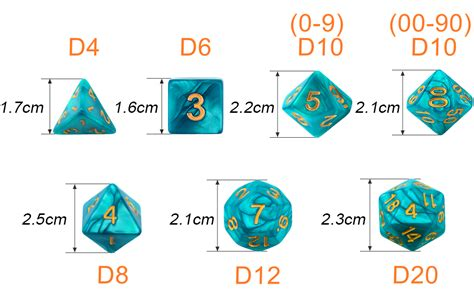 Roleplaying game dice have a wider variety than in board games, where they are inevitably 6-sided dice. It was common for early RPGs to use a set of polyhedral dice, and a notation was needed to explain which dice to roll.
The most common dice notation is dY, where Y denotes the number of sides of the die. A polyhedral set typically contains a d4, d6, d8, d10, d12, and d20, in the shapes of the Pythagorean solids, and due to D&D's popularity, the term "d20" became emblematic of the hobby. Such a dice set will often contain a second d10 numbered 00, 10, 20, …, explained below. #Non-standard dice are also possible.
Unlike the dice found in most board games, roleplaying dice typically have plain numbers printed on them instead of pips (dots). Roleplaying games typically call for players to roll more dice than board games, so barriers to quick math like pips and stylized fonts are eschewed. The illustration also gives typical dimensions for polyhedral dice sets.
Dice also come in a variety of colors, materials, and styles, and are considered a form of expression, either of the Player or sometimes a player character. For example, the player of a magician who often casts fireballs might wield yellow and orange swirl dice with vivid red numbering to the table. A Game Master of a horror game might choose dice that look like human bones.
Dice notation
A common notation extension is XdY, where X is the number of dice of type Y to roll. For example, 3d6 means to roll three six-sided dice. Games that use this notation may distinguish between, say, d8 (the die type) and 2d8 (roll one 8-sided die, and sum the results). Many games only require this XdY notation, combined with +Z/-Z, add or subtract the fixed value Z to the roll (ex: 2d6+1).
A few systems like GUMSHOE use a dice pool mechanic, in which a person has a pool or set of dice available. When a roll is called for, the person rolls those dice in the pool and counts the number of dice whose value is greater than or equal to a threshold. Instead of a variable threshold, in Worlds of Darkness systems like Vampire the Masquerade, an 8 or higher on a d10 is termed a "success", and the roll result is the number of successes achieved. (Examples are shown in Raine Frostdancer.)
In yet other systems, instead of rolling all the dice, the dice pool is a resource to be managed. The player chooses how many dice from their pool to roll, and thus how many to keep in reserve.
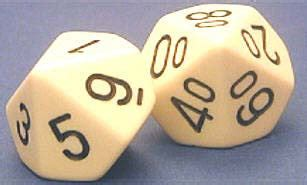 Another common notation is
 d% or d100, which means roll two 10-sided dice. This was common in FASA games, and in other games that use lookup tables. One die is the ten's place die, and the other is the one's place die. When the results are combined, the result is a two digit number. The result 00 is interpreted as 100, yielding a range of possible values from 1-100. A 10-sided die of a different color can serve as a ten's place die if a specialized one isn't available. (The pictured result is 81.) Rarely, d1000 is also seen.
The specified dice are rolled, and then the corresponding entry becomes the roll result.
| Roll (d12) | Treasure Found |
|---|
| 1–3 | Moldy tomes, broken quills, worthless scraps, and 2d4 copper coins.
| 4–5 | A small pouch of coins (2d20 copper, 1d10 silver).
| 6–7| Alchemical supplies worth 20 gp, slightly unstable.
| 8| A minor scroll (random 1st-level spell).
| 9–10| An enchanted trinket (glowing amulet, wand tip, lucky charm).
|11| Rare scroll (roll 1d3: Fireball, Lightning Bolt, or Counterspell).
|12+| Major magical item – Staff of Forgotten Spells or similar relic.
It's not uncommon for the entries to be sorted in a certain way, and for a type of character to get bonuses or penalties to a roll, making certain outcomes more or less likely. For example, "add +2 to rolls if the searching character is a Wizard", making magic items more likely for wizards.
Extended notation
Dice notation can be extended with:
xZ, roll the dice and multiple the sum by Z (ex:d6x10+d6or sometimes5x2d6)kZ, roll the dice and keep Z of them (ex:4d6k3)- sometimes written
kZc, keep the person's choice kZh, keep the highestkZl, keep the lowest
- sometimes written
For example, in D&D, a common attribute roll is 4d6k3h, in which the person roles 4 six-sided dice and keep the three highest values. A common mechanic is to "role advantage" (2d20k1h) or disadvantage (2d20k1l).
Another extension mechanic is exploding dice: if a die result is the die type's highest value (ex: 6 on a d6), not only is that value added to the result, but the person rolls that die again and adds the bonus role to the result. This is commonly written 6d6!.
Some games use d6-d6, with two d6s of different color such as black and white. Instead of taking the sum of the dice, the person takes the difference of the white die from the black. This yields a range of -5 to +5, similar to a dF. In the Time Lord RPG, the absolute value of the difference is used, so the range is 0 to +5 instead.
Non-standard dice
Fantasy Flight's Star Wars RPG line like Edge of the Empire use custom 6-sided dice with distinct icons, not standard d6. They include green (for skill checks), blue (for combat), white (for initiative), and red (for critical successes). These dice are part of their "Dice System", which blends narrative and mechanics, allowing players to resolve actions like combat, skill challenges, and storytelling through color-coded rolls.
dF
 In Fate and Fate Accelerated, special Fate dice are used, denoted
 dF. The dice are custom six-sided dice with two sides marked "+", two sides "-", and two sides blank. Mathematically, a dF is equivalent to d3-2, with a range of -1 to +1.
 The most common roll is 4dF, yielding a range of -4 to +4 (see the chart). Compared to 3d6 (GURPS), 4dF has a heightened bell curve, making median (+0) results more likely. The effect on gameplay is that random variation overshadows +1 and dampens +2 bonuses on opposed rolls (4dF-4dF).
The dice were developed for Fate's ancestor, Fudge, and they are sometimes called Fudge dice.
Non-standard sizes
Other games use non-standard die sizes, like a 30-sided die (d30). In the 80s, there was a book of random tables for a d30, to encourage people to buy the dice.
Rarely, a game will call for some non-standard dice, but these can be simulated easily:
- A d2 is a coin flip, a "2-sided die".
- A d3 is a d6, where the result is halved, rounded up (thus, 1 or 2 yields a 1, and so on).
- A d5 is a d10, where the result is halved, rounded up.
- For a d16, you could use a d20 and re-roll any result above 16.
Until recently, it wasn't possible to purchase dice in these unusual sizes. In the 2020s, online retailers began selling them, and I've started to see them in brick-and-mortar stores also.
Non-standard shapes
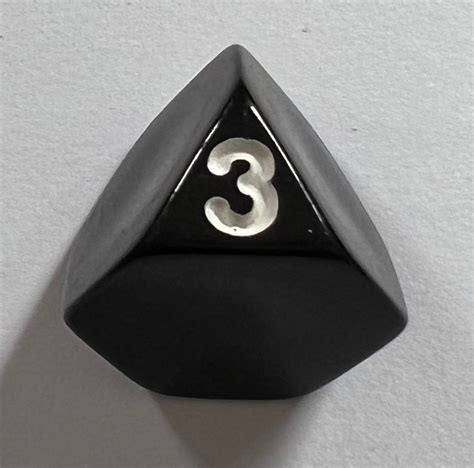 Some manufacturers make alternate shapes for dice. For example, there is a "truncated" d4 that designed with flat points containing the numbers. This alternate design is read like other dice, and its rounded corners prevent injuries from stepping on them. (Some players jokingly refer to regular d4s as "caltrops" for this reason.)
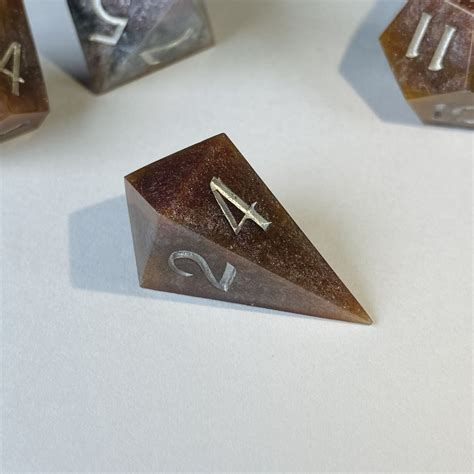 Another style is a crystal-shaped, either with sharp or rounded ends, which come in d4, d6, d8, and d10.
There are also spinners and other non-dice randomizers, which have the virtue of being more portable. Few players I know rely on random number generator programs on phones and tablets unless pressed.